tag:beijing.nd.edu,2005:/news-stories/newstag:beijing.nd.edu,2005:/latestNotre Dame Beijing | News2026-11-03T09:15:00-05:00In a thriving metropolis rich in history, culture, commerce, and political influence, sits Notre Dame’s home in Asia, the Beijing Global Gatewaytag:beijing.nd.edu,2005:News/1866832026-11-03T09:15:00-05:002026-11-03T09:16:02-05:00Notre Dame Campus Ministry announces Global Saints Initiative in Basilica of the Sacred HeartBasilica of the Sacred Heart (Photo by Matt Cashore/University of Notre Dame)
For nearly 140 years, the Basilica of the Sacred Heart at the University of Notre Dame has stood at the center of campus, inviting students, staff, faculty, and visitors alike to celebrate the sacraments and be inspired by the saints depicted in its stained-glass windows and murals.
In early 2027, several new saints will be added to the sacred space in the form of icons displayed on columns inside the nave of the church. Known as the Global Saints Initiative, the installation will feature saints from five continents and nine countries to both represent the many cultural dimensions of the global Catholic Church and reflect the experiences of current Notre Dame students.
“Just as university founder Father Edward Sorin carefully selected saints for the Basilica that spoke to the Notre Dame students of his day, these new icons reflect the diverse vocations, cultures, and backgrounds of today’s campus community and the wider Church,” said Rev. Pete McCormick, C.S.C., assistant vice president for campus ministry. “I am incredibly grateful to have the opportunity to share these stories of holiness with all who visit the Basilica and especially with our students who I’m hopeful will be able to identify with and learn from these witnesses of faith.”
The icons were made possible through a generous gift from longstanding benefactors and Notre Dame alumni Jay and Mary Flaherty. The niece of the late Rev. Theodore M. Hesburgh, C.S.C., president of Notre Dame from 1952 to 1987, Mary is a member of Notre Dame’s Undergraduate Experience Advisory Council, and her husband, Jay, is a member of the University’s Board of Trustees. The Flahertys have supported several University initiatives, including the construction of Flaherty Hall, which opened as a female residence hall in 2016.
“Our support of the University of Notre Dame honors the life and the theme of Rev. Theodore M. Hesburgh, C.S.C., that began with the Basilica of the Sacred Heart World War I Memorial and went on to be depicted in his autobiography, God, Country, Notre Dame,” said Mary and Jay Flaherty. “We are overjoyed to see one of Notre Dame’s most sacred and timeless spaces even more profoundly reflect the beauty of our faith, the richness of the global Catholic Church, and the universality of the call to holiness embodied in these icons.”
To complement the icons, Notre Dame’s Global Catholic Research Initiative will offer a one-credit course through the Department of History in spring 2027. The course, titled Global Saints, will be taught by Kathleen Sprows Cummings, director of the Global Catholic Research Initiative and the John A. O’Brien Collegiate Professor of American Studies and History, and Anna Katharina Rudolph, managing director of the Global Catholic Research Initiative and research affiliate with the Medieval Institute. The course will invite students to visit the installation, consider what makes a saint “global” and analyze how saints have served—and continue to serve—as sites of cultural encounter, political expression, gendered authority, and the Church’s evolving relationship to its past.
The icons are scheduled to be installed in the Basilica in January 2027, just prior to the start of the spring semester. The announcement of the installation coincides with All Saints’ Day, a holy day celebrated annually on November 1, which is dedicated to the saints of the Catholic Church who are now in the presence of God in heaven. To learn more about the icons, visit the Basilica website.
Media Contact: Erin Blasko, director of media engagement, 574-631-4127, eblasko@nd.edu
Originally published by Kate Morgan at news.nd.edu on November 02, 2026.
]]>
Kate Morgantag:beijing.nd.edu,2005:News/1864712026-10-23T10:26:00-04:002026-10-23T10:26:29-04:00Notre Dame Global showcases the research and professional impact of international learning
Each summer, Notre Dame Global’s study abroad office sends undergraduates to major global centers like Mexico City, Santiago, São Paulo, Rome, Nairobi, Beijing, Mumbai, Hong Kong, and Taiwan to get a head start on research and career opportunities. Under the banners of the Global Professional Experience (GPE) program, Global Research Experience (GRE) program, and programs like Vietnam Summer: Intro to Design Thinking, participants take on research and experiential learning with Notre Dame’s research and career development partners.
This fall, the study abroad office hosted its first annual poster fair, where students from the programs were invited to share their research and experiences. Carrie Anne Thomas, one of the event’s organizers, said that the fair represented a wide range of student projects. "We had eight great poster submissions in two categories (research and experiential) from three programs (GRE, GPE, and Intro to Design Thinking in Vietnam), representing five global locations.”
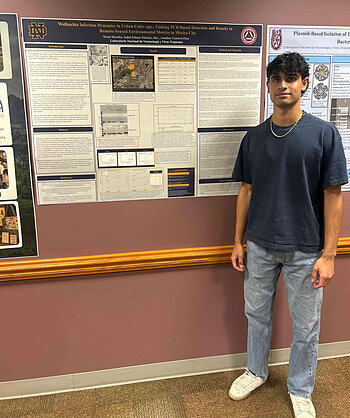
Sri Moorthy
The Notre Dame Global selection panel named two winners: Sri Moorthy (research poster category) and Ella Bussell (experiential poster category). Moorthy participated in the GRE program working for a Mexico City-based laboratory on disease detection in mosquitoes. His project, “Wolbachia Infection Dynamics in Urban Culex spp.: Linking PCR-Based Detection and Density to Remote-Sensed Environmental Metrics in Mexico City,” studied how the prevalence and density of Wolbachia bacteria differed in mosquitoes across different regions of the city.
Moorthy reported that he was able to design his own project and carry it out over the course of the summer, with supervision from his lab. He remarked that this represented a rare level of independence that he appreciated in his research.
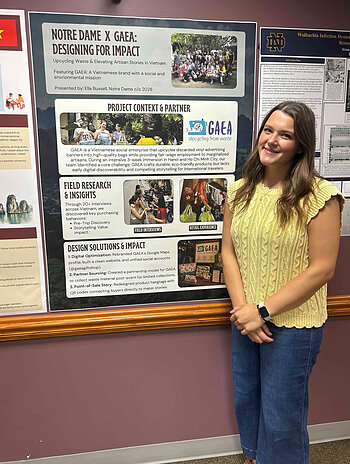
Bussell’s presentation, “Seeing The Good As A Tool To Innovate,” detailed her efforts to aid Vietnamese upcycled purse brand GAEA with its marketing efforts. GAEA diverts vinyl advertising banners away from landfills, and it provides fair-wage employment to local artisans. Nevertheless, before Bussell’s project, it lacked online discoverability. Bussell, who participated in the Vietnam Summer: Intro to Design Thinking program, helped to craft a new website and social media presence for the company, and established new sourcing partnerships and merchandising strategies.
Ella Bussell
Participants said that their experiences abroad helped them to gain depth in their fields and get the chance to live in a new place. According to Bussell, “Living in Vietnam allowed me to better understand the resiliency and resourcefulness of the local community. During my time living among and studying the cities of Hanoi and Saigon, I was able to notice small cultural practices that compounded into large pieces of the Vietnamese identity. Beyond this, I was able to reflect on my differing global experiences in a comparative context.”
Honorable mention winners included Frank Quian for his research poster titled “Proposal of FAP x VCAM-1 Bispecific Dual-Payload Antibody-Drug Conjugate for Joint Regeneration in Rheumatoid Arthritis with Osteoarthritis Features” and Bryce Miller for his research poster titled “Effective Humanization Strategies regarding Mental Illness and Substance Use Disorder related issues in Emergency Medicine: A Scoping review."
The Notre Dame Global study abroad office encourages students who are interested in the GRE, GPE, and other summer abroad programs such as Intro to Design Thinking Intro to Design Thinking to submit applications in advance of the November 15 deadline. More information about summer programs can be found on their website.
Originally published by Zakir Jamal at studyabroad.nd.edu on October 16, 2026.
]]>
Zakir Jamaltag:beijing.nd.edu,2005:News/1857952026-09-28T11:01:43-04:002026-09-28T11:01:43-04:00Notre Dame Beijing launches book talk series on “Pedagogy and Perspective in International Chinese Instruction”
In 2026, Notre Dame Beijing launched the Book Talk series to provide Notre Dame faculty and scholars with a platform to present their research, engage with scholars in China, and explore future collaboration, including possible co-authored publications.
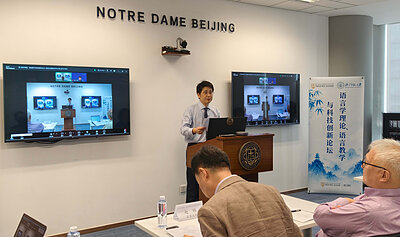
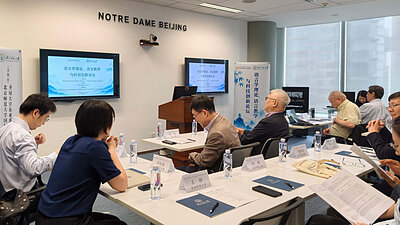
The book talk, titled “Pedagogy and Perspective in International Chinese Instruction,” was successfully held at Notre Dame Beijing on July 4, 2026. Sponsored by Notre Dame Beijing, the event examined grammar pedagogy and cultural narratives, featuring two major works co-authored by faculty members from the Department of East Asian Languages and Cultures at the University of Notre Dame.
Professor Yongping Zhu (University of Notre Dame) presented A Student Grammar of Chinese (Cambridge University Press, 2023). In his 30-minute presentation, Professor Zhu outlined the core goals and significance of his book project within the field of Teaching Chinese as a Second Language. Using engaging and accessible language, the volume examines the Chinese sound and writing systems, word formation rules, parts of speech, and sentence structures, while demystifying complex syntactic patterns and special constructions that typically challenge non-native learners. Professor Ying Lu (Beijing Union University) joined as a discussant to further explore effective pedagogical strategies for Chinese grammar instruction.
Next, Professor Jincheng Liu (University of Notre Dame) and his co-authors, Professor Chih-p’ing Chou (Princeton University) and Professor Xin Zou (NYU Shanghai), presented Small Things Writ Large (Princeton University Press, 2026), an intermediate reader exploring China’s rapid evolution through minor social phenomena. The authors reflected on 40 years of the Princeton University Chinese Language Program curriculum, analyzing how the pedagogical portrayal of China has evolved from a critical lens to one of nuanced, multi-dimensional understanding. Together, the presentations offered a comprehensive look at the changing landscape of Chinese language and culture education within the Princeton Model.
Jingyu Wang, executive director of Notre Dame Beijing, said: “Through this program, we hope to showcase the academic achievements of Notre Dame faculty to international audiences while supporting further research collaboration and co-authored publications with scholars around the world. We are grateful to Professor Yongping Zhu and Professor Jincheng Liu for sharing their research at Notre Dame Beijing’s inaugural Book Talk.”
The book talk received 363 registrations from participants representing 230 institutions and organizations across 24 countries and regions, including the United States and China, sparking lively exchanges and meaningful debates on handling nuanced social topics in the language classroom.
Beyond celebrating two landmark publications, the book talk served as an invaluable platform for academic dialogue. By bridging fundamental linguistic theory with innovative cultural pedagogy, the event inspired educators to adopt systematic, effective teaching methods that elevate students' language proficiency while actively cultivating their critical thinking skills—leaving a lasting, positive mark on the field of International Chinese Education.
]]>
Prof. Jincheng Liu and Notre Dame Beijingtag:beijing.nd.edu,2005:News/1854662026-09-11T09:17:00-04:002026-09-14T08:17:36-04:00Annual Linguistic Research and Language Teaching Innovation Forum returns to Notre Dame Beijing
The Linguistic Research and Language Teaching Innovation Forum returned to Notre Dame Beijing for its second year from July 2 to 3, 2026, building on the success of its inaugural gathering in 2025.
This year’s forum, themed “Linguistic Theory, Language Teaching and Technology Innovation,” was co-hosted by the Chinese Language Program in the Department of East Asian Languages and Cultures at the University of Notre Dame and the School of International Chinese Language Education (SICLE) at Beijing Normal University (BNU), with operational support from Notre Dame Beijing. Generously sponsored by the Franco Family Institute at Notre Dame, SICLE at BNU, and Notre Dame Beijing, the event fostered insightful academic exchanges among international scholars on key issues in Chinese linguistics and International Chinese Language Education, with a special focus on the integration and influence of AI.
Professor Jincheng Liu
The two-day forum was chaired and moderated by Professor Jincheng Liu of the University of Notre Dame, who also served as the U.S. Vice Chair. Opening remarks were delivered by the U.S. Chair, Professor Yongping Zhu (University of Notre Dame); the Chinese Chair, Professor Liping Feng (dean of SICLE at BNU); and Ms. Jingyu Wang (executive director of Notre Dame Beijing). They extended a warm welcome to the attending experts and scholars, expressed sincere gratitude for the long-standing support from all sponsoring parties, and voiced their hopes that these in-depth exchanges would further advance academic cooperation and discipline development in the field of International Chinese Language Education.
The forum featured 16 exceptional academic presentations by renowned scholars from leading universities in China and the United States. Covering a wide range of cutting-edge domains in International Chinese Language Education—from fundamental linguistic research and cultural pedagogy to second language acquisition and AI applications—the presentations both reaffirmed the essential theoretical foundations of language teaching and actively addressed new challenges facing the field in the AI era. Attendees engaged in lively, meaningful discussions following each presentation, deepening the core themes and broadening the scope of research.
Closing remarks were delivered by Professor Chih-p’ing Chou of Princeton University and Professor Yang Zhao of Peking University, who congratulated the organizers on the forum's resounding success. They also expressed high hopes for further strengthening academic exchanges between linguists in China and the U.S., while continuously driving innovation and development in linguistic research and International Chinese Language Education.
Professor Yongping Zhu attributed the success of the forum to the high-quality academic presentations by distinguished scholars, as well as the strong support of the collaborating institutions and Notre Dame Beijing. He expressed his confidence that the forum’s distinctive approach—bringing together cutting-edge theories, pedagogical practices, and technological developments to explore issues in language research and teaching—would have a positive impact on both the linguistic and language-teaching communities.
Conducted in a hybrid format, the forum attracted over 463 registrants from 278 institutions and organizations across 28 countries and regions—spanning North America, Asia, Europe, and Oceania. Attendees represented premier global institutions, including Princeton University, Stanford University, Yale University, Peking University, the University of Hong Kong, and the University of Macau, fully demonstrating the forum's international reach and significant global interest.
]]>
Prof. Jincheng Liu and Notre Dame Beijingtag:beijing.nd.edu,2005:News/1849642026-08-21T08:21:00-04:002026-08-21T08:21:21-04:00Two Notre Dame faculty members and University Trustee appointed by Pope Leo XIV as consultors to the Dicastery for Promoting Integral Human DevelopmentEmmanuel Katongole, Clemens Sedmak, and Kathryn “Katie” Koch have been appointed by Pope Leo XIV as consultors to the Dicastery for Promoting Integral Human Development.
On Tuesday (Aug. 18), Pope Leo XIV appointed two University of Notre Dame faculty members, Emmanuel Katongole and Clemens Sedmak, as consultors to the Dicastery for Promoting Integral Human Development. University Trustee Kathryn “Katie” Koch, president and CEO of TCW, a global investment management firm, was also named a consultor.
Katongole, a professor of theology and peace studies and director of the Ansari Institute for Global Engagement with Religion; Sedmak, a professor of social ethics and director of the Nanovic Institute for European Studies; and Koch are among 12 new consultors from around the globe—and the only three selected from within the United States. They have been appointed for a five-year term.
Consultors may be religious or laypeople and are chosen “from among the faithful who are distinguished by their expertise, proven ability, and prudence,” according to the Vatican’s announcement.
“These appointments are a tremendous honor not only for Emmanuel, Clemens, and Katie, but for the University as a whole,” said Notre Dame President Rev. Robert A. Dowd, C.S.C. “We congratulate them on their selection, and we are deeply grateful for the Holy Father’s recognition of their expertise and abiding commitment to the Church. We look forward to the ways their leadership and wisdom will guide the important work of the dicastery.”
Established by the late Pope Francis in 2016, the Dicastery for Promoting Integral Human Development supports the Church’s worldwide efforts in the areas of human dignity and human rights, economic justice, care for creation, migration, and displacement, as well as peace, conflict, and humanitarian crises.
Katongole, who came to Notre Dame in 2013, holds a joint appointment in the University’s College of Arts and Letters and Keough School of Global Affairs. A native of Kampala, Uganda, and a priest of the Kampala Archdiocese, he is the founder and president of Bethany Land Institute, a residential agricultural institute that works with young people to realize the vision, spirituality, and practice of Laudato si’ in Uganda. Before joining the Notre Dame faculty, he served as an associate professor of theology and world Christianity at Duke University and was a founding co-director of the Duke Center for Reconciliation. He earned a Bachelor of Divinity at the Pontifical University Urbaniana in Rome, as well as a master’s in religious studies and a doctoral degree in philosophy from the Catholic University of Louvain in Belgium.
Sedmak, a concurrent professor of theology, holds a joint appointment in Notre Dame’s Institute for Social Concerns and the Keough School. His research focuses on issues of poverty, justice, and the Catholic social tradition, as well as a collaboration with Notre Dame colleagues on the Church’s role in acclimating refugees into Italian society. A native Austrian, Sedmak holds a doctoral degree in theology from the Catholic Private University of Linz and doctoral degrees in philosophy and social theory from the University of Innsbruck. Prior to joining Notre Dame, Sedmak served as the F.D. Maurice Professor for Moral Theology and Social Theology at King’s College London. He also held multiple positions at the University of Salzburg and was president of the Institute for Advanced Studies in Social Ethics in Salzburg.
Koch, a Notre Dame alumna, was named a University Trustee in 2023. Prior to moving to TCW, she spent 20 years at Goldman Sachs in a variety of leadership positions, including chief investment officer of public equity. She graduated from Notre Dame in 2002 with a Bachelor of Arts in economics and English.
Originally published by Carrie Gates at news.nd.edu on August 20, 2026.
]]>
Carrie Gatestag:beijing.nd.edu,2005:News/1829212026-07-07T13:59:00-04:002026-07-07T14:00:01-04:00Notre Dame Arts Initiative awards over $400,000 for community and campus partners to lead inaugural Arts Biennial programming
The Notre Dame Arts Initiative has awarded 38 grants to foster sustained growth in the arts through partner programming for the inaugural Notre Dame Arts Biennial, scheduled for January through June of 2027. Awardees include 16 regional community partners, 19 campus units, and four Notre Dame Global locations, with another 60 campus units and external organizations involved as collaborators. In addition to funding, partners receive administrative support from Arts Initiative staff for planning, implementation, and promotion.
Projects include theatrical premieres, regional dance and music festivals, multimedia installations, visual art and architecture exhibitions, high-impact arts education programs, international artistic exchange, and more. Biennial programming is open to the public, and events will be held on Notre Dame’s campus, in and around South Bend, and at select global locations.
Occurring every two years, the biennial is an international arts festival rooted in the creative spirit, intellectual energy, and iconic traditions of Notre Dame and the region. Predominantly free programming across the visual, spatial, literary, and performing arts will contribute to the region’s long-term flourishing by enhancing quality-of-life and quality-of-place and by providing new platforms for arts research to positively impact the public.
In his inaugural address, University President Rev. Robert A. Dowd, C.S.C., urged the Notre Dame community to be builders of bridges to live out our mission as a leading global Catholic research university. The biennial is one of the most visible ways the Arts Initiative is responding to that call.
“This scale of coordination and collaboration is unprecedented,” said Michael Schreffler, director of the Notre Dame Arts Initiative. “We are grateful to all of our partners for bringing their energy and leadership to fully realize the vision of the biennial’s inaugural theme of symbiosis: a call to contemplate mutually-beneficial relationships through the arts and create them together in practice.”
Community partners leading biennial programming reflect the strength and diversity of arts and culture across the region. Participating regional community partners include:
Abby Marchesseault Dance Collective
Acting Ensemble
Equity in the Arts, an initiative of South Bend Venues Parks & Arts
Goshen College Music Center
Fischoff National Chamber Music Association
The History Museum
Lubeznik Center for the Arts
Merrimans’ Playhouse
New Industry Dance
Performing Media Festival, produced in partnership with IU South Bend
Saint Mary’s College, Department of Art
South Bend Civic Theatre
South Bend Community School Corporation
South Bend-Elkhart Regional Partnership
South Bend Museum of Art
South Bend Symphony Orchestra
Campus units awarded funding for partner programming similarly span artistic media and represent a University-wide commitment to interdisciplinary innovation. In addition to projects housed in arts departments, campus efforts are also being led by the College of Science, Hesburgh Libraries, the School of Architecture, and a range of interdisciplinary centers and institutes.
Beyond robust support for partner projects, the biennial also closes gaps in cultural access by attracting prominent artists to the region and making the highest-caliber arts experiences available to the public. In addition to world-class artists hosted by the Arts Initiative, signature performances, convenings, and exhibitions aligned with the biennial’s inaugural theme will be hosted by the DeBartolo Performing Arts Center, the Franco Family Institute for Liberal Arts and the Public Good, and the Raclin Murphy Museum of Art.
A dual emphasis on local and visiting artists is a hallmark of Notre Dame’s biennial. “We’re not aware of any other U.S. university currently curating a biennial of this nature and scale,” said Rebecca Struch, Arts Initiative managing director. “Establishing a groundbreaking biennial in northern Indiana, a place with an evolving but often overlooked arts scene, will advance the region as a global gathering place for arts and inquiry.”
“The Notre Dame Arts Biennial reflects what’s possible when our community and local institutions work together,” said South Bend Mayor James Mueller. “This effort will activate our public spaces, support local artists, and strengthen the connections that make South Bend a vibrant place to work and live.”
The Arts Biennial launches at a pivotal moment for the arts across the region and on campus. Informed by its Catholic character, the University’s most recent strategic framework identifies the arts as a key priority and calls for deeper engagement with South Bend and the region. The South Bend-Elkhart region also recently adopted a new Arts & Culture Plan. The biennial builds on these developments by nurturing the arts as a shared community asset that strengthens social bonds and shapes place-based identities.
Contact: Rebecca Struch, Arts Initiative managing director, 574-631-9845, rstruch@nd.edu
Originally published by Arts Initiative at arts.nd.edu on July 06, 2026.
]]>
Arts Initiativetag:beijing.nd.edu,2005:News/1813462026-05-04T08:09:52-04:002026-05-04T08:09:52-04:00International partners boost peace agreement success, Notre Dame study finds
Over the past 50 years, nearly 4 in 10 peace agreements have failed within five years of signing. New research shows that when international partners help implement an accord, the odds improve — and the deeper their engagement, the better.
Colombia’s 2016 peace accord ended over 50 years of armed conflict. It has had high levels of global support, from negotiation to implementation. Photo by Gobierno de Chile (Government of Chile), CC BY 2.0, via Wikimedia Commons.
That’s according to a study by University of Notre Dame researcher Madhav Joshi. The study, published in the Journal of Intervention and Statebuilding, shows how the visible, on-the-ground presence of partners such as foreign countries, multilateral institutions and policy advocacy organizations keeps peace agreements on track by raising reputational costs for leaders who fail to implement them.
Joshi’s research drew on evidence from the historic 2016 Colombian peace accord between the government and the Revolutionary Armed Forces of Colombia-People’s Army (FARC-EP), which illustrates these dynamics in practice.
The Colombian agreement has had high levels of global involvement, from negotiation to implementation. More than 30 international actors have helped support the agreement, including the European Union, the United Nations Development Programme, the Carter Center and the U.S. government.
Joshi used data from the Peace Accords Matrix Barometer Initiative, which is responsible for monitoring and verifying implementation of the accord. This is the first time a university-based research center has played such a direct role in supporting the implementation of a peace agreement, and the first time researchers have measured the implementation of a peace accord in real time.
Drawing on this data, Joshi tracked 578 individual commitments from December 2016 through April 2023. He found that international support, and the depth of that support, directly improved implementation outcomes.
Previous research has shown that domestic leaders often fail to implement peace agreements either because they are politically costly or because leaders lose domestic political support. Joshi found that international partners bring expertise and resources to support the aspects of agreements that are most at risk. Crucially, he also found that partners’ involvement increases the visibility of these agreements. That motivates leaders to work through obstacles rather than risk losing face on the global stage.
“When domestic actors face higher reputational costs, they are less likely to shirk their commitment to implementing peace,” Joshi said.
Colombia’s story reflects these findings, Joshi said. When Iván Duque won the Colombian presidency in 2018 by rallying voters against the peace agreement, extensive international involvement meant he couldn’t walk away from it, despite his campaign promise.
Informing global peace policy and practice
Joshi’s research examines why peace agreements succeed or fail. These insights are an important part of the Peace Accords Matrix and its ongoing work to inform frontline policymakers and practitioners.
The new study builds on Joshi’s broader body of work, which examines why peace agreements succeed or fail. Previous research has explored how partial agreements can pave the way for more comprehensive deals and how addressing gender issues strengthens accords.
Joshi’s work plays a central role in the Peace Accords Matrix. It maintains the world’s largest collection of implementation data on intrastate peace agreements, informing the work of policymakers and practitioners.
The latest study carries direct implications for how future agreements are designed, Joshi said, adding that partners should be built into strategies from the start.
“To maximize the chances for success, negotiators should design strategies to incorporate partners before the agreement is signed and deploy them as soon as implementation begins,” Joshi said.
Contact: Tracy DeStazio, associate director of media relations, 574-631-9958 or tdestazi@nd.edu
Originally published by Josh Stowe at keough.nd.edu on April 28, 2026.
]]>
Josh Stowetag:beijing.nd.edu,2005:News/1807682026-04-14T07:35:00-04:002026-04-14T07:35:18-04:00Statement from University President Rev. Robert A. Dowd, C.S.C., in support of Pope Leo XIV
“Pope Leo XIV continues to proclaim the Gospel of Christ by upholding human dignity and serving as a tireless advocate for peace. His message transcends partisan political divisions in this or any country and I’m deeply grateful for Pope Leo’s inspiring example. I ask members of the Notre Dame community to pray for peace and work together with all people of goodwill to build a more just and humane world.”
Rev. Robert A. Dowd, C.S.C. President, University of Notre Dame
Originally published by Notre Dame News at news.nd.edu on April 13, 2026.
]]>
Notre Dame Newstag:beijing.nd.edu,2005:News/1803422026-03-26T17:13:00-04:002026-03-26T17:13:10-04:00Notre Dame Department of Theology ranked best in the world for second consecutive year
The University of Notre Dame has again been ranked as the world’s best theology, divinity, and religious studies program by the influential QS World University Rankings. This is the second consecutive year and the fifth time since 2020 that the Department of Theology has received the No. 1 distinction.
The ranking is based on academic reputation, employer reputation, and research impact. Out of 150 universities included, Notre Dame’s score of 92.2 bested the University of Oxford (89.2), Harvard University (89.1), Durham University (88.7), and Boston College (88.3).
“To be ranked No. 1 in the world for two years in a row is a momentous accomplishment for which all our faculty and staff deserve great credit,” said Fr. Khaled Anatolios, the John A. O’Brien Professor of Theology and chair of the department. “As a department, we take the measure of our own performance less from external rankings than from fidelity to our mission. Nevertheless, these consistently top rankings demonstrate that our fidelity produces scholarly results that are literally second to none in commanding international admiration.”
In addition to offering a doctorate and four master’s degree programs, Notre Dame’s theology department maintains a strong commitment to undergraduate education by supporting more than 800 theology majors or minors and teaching the theology courses that all Notre Dame students take as part of the University’s Core Curriculum.
Originally published by Arts & Letters at al.nd.edu on March 26, 2026.
]]>
Arts & Letterstag:beijing.nd.edu,2005:News/1801122026-03-19T08:06:38-04:002026-03-19T08:06:38-04:00Notre Dame announces that families with incomes under $150,000 will pay zero tuition
The University of Notre Dame today announced significant enhancements to its undergraduate financial aid program, marking a bold expansion of the Pathways to Notre Dame initiative.
Beginning in the 2026-27 academic year, Notre Dame will ensure that families with annual income below $150,000 will receive need-based financial aid that covers the cost of tuition. Families with income below $200,000 will receive need-based aid that covers half the cost of tuition. In addition, most students from families with annual income below $60,000 will receive need-based financial aid that covers tuition, fees, housing and food. This announcement reflects the University’s long-standing commitment to ensure a Notre Dame education is affordable and accessible to students from all socioeconomic backgrounds, and this expansion of Pathways to Notre Dame provides the clarity that families need during the admissions process.
University President Rev. Robert A. Dowd, C.S.C., launched the Pathways to Notre Dame initiative in his September 2024 presidential inauguration speech, when he announced that Notre Dame would be need-blind and loan-free for all students, domestic and international. “In order to be the community of learning we are called to be, cost must never be a barrier. By expanding the Pathways to Notre Dame program with this announcement, we continue to make strides to make a Notre Dame education more affordable," Father Dowd said. "We are committed to making every effort to welcome talented young people from a variety of backgrounds to a Notre Dame community that will help them to develop their gifts. I have no doubt that the students who come to Notre Dame thanks to Pathways will enrich our community in every way.”
“I am grateful that Notre Dame is expanding the Pathways to Notre Dame program,” said Micki Kidder, vice president for undergraduate enrollment. “With this announcement, we reiterate our unwavering commitment to ensuring that cost will never be a barrier between a promising student and a Notre Dame education, and we are ensuring that families have greater clarity as they consider this important and formative step for young scholars. Navigating the financial aid process can often feel like the most daunting part of the college selection journey. By implementing income-based scholarship thresholds, we are providing the clarity families need to see that a world-class education is within their reach.”
As the preeminent global Catholic research university, Notre Dame remains dedicated to every member of its community. Notre Dame will continue to meet 100% of demonstrated need for all admitted students, both domestic and international. For the past three decades, Notre Dame has provided significant need-based scholarship support to meet families’ full financial need. However, the Pathways to Notre Dame program expands the University’s commitment to affordability in historic ways. In the next four years, supported by the generosity of many members of the Notre Dame family, the University’s undergraduate financial aid commitment will exceed $1 billion.
Originally published by Media Relations at news.nd.edu on March 18, 2026.
]]>
Media Relationstag:beijing.nd.edu,2005:News/1789542026-02-04T09:20:00-05:002026-02-04T09:20:05-05:00Notre Dame Beijing presents ‘Heavenly Horse,’ the featured artwork for the Lunar New Year
Starting in 2021, Notre Dame Beijing presented a series of Chinese Zodiac ink paintings to celebrate the Lunar New Year, bringing traditional Chinese art into dialogue with the University’s global community and partners. For 2026, the Year of the Horse, Notre Dame Global launched an open call for artwork submissions. We are happy to announce that the selected work is Heavenly Horse, created by Yien (Ian) Tan, a 14-year-old aspiring painter.
Yien began his systematic study of Chinese painting in early 2024, attending weekly painting lessons. He shared that he feels a personal connection to this zodiac sign: “Several members of my family were born in the Year of the Horse. This sense of closeness inspired me to create a work centered on the horse as a symbol of hope, strength, and forward movement.”
'Heavenly Horse' by Yien (Ian) Tan
In conceptualizing Heavenly Horse, Yien drew inspiration from a wide range of sources. The image of the white horse in the New Testament’s Book of Revelation first came to mind, which he associated with justice, goodness, and hope. He envisioned a horse standing tall, wings outstretched, conveying purity, dignity, and quiet strength. At the same time, he hoped to use rich, vibrant colors to express his blessings for family and friends.
Beginning in September 2025, Yien studied classical Chinese painting through intensive practice. He spent two months copying line drawings and colored versions of Five Drunken Princes Returning on Horseback from the Tang Dynasty, gradually mastering the proportions and structure of the horse’s body. In October, he studied One Hundred Horses, learning about the many postures, forms, bridles, and saddles depicted in traditional Chinese art. To incorporate wings into the composition, he also researched illustrated collections on Angels, ultimately selecting a form that best complemented the spirited posture of a rising horse.
By November, Yien moved into independent creation. Bringing together what he had learned, he added wings to the horse, selected saddle patterns, and introduced Chinese ancient Dunhuang-Art-inspired colors to enrich the visual language of the piece. To complete the work, he also carved a personal seal featuring his English name, an intentional and creative departure from the tradition of using only Chinese characters in seals.
Yien explained his painting: “In Heavenly Horse, each detail carries symbolic meaning. The gentle yet expressive eyes represent care and guidance; the subtle smile reflects optimism and joy; the upright stance suggests growth through effort; and the golden wings symbolize freedom and the brightness of youth. The central figure–a young horse not yet fully grown–faces the future with courage and determination.” Through his artwork, Yien offers his wishes to the Notre Dame community for the Year of the Horse: “I hope everyone may move forward with confidence, resilience, and hope, and that the year ahead may be as vivid and full of life as the colors in the painting.”
A Note from Yien’s Father
Yien’s father, Qin Tan, also shared reflections on his son’s artistic journey:
“From a young age, Yien, his younger brother, and our family have read the Bible together, explored masterpieces of art, and visited museums. About a year and a half ago, he began a systematic study of Chinese calligraphy and painting.
Throughout the creative process, Yien’s dedication to conception, painting, seal carving, mounting, and articulating his ideas, along with our family’s ongoing discussions about culture and meaning, became a deeply memorable experience. Delivering the artwork to Notre Dame Beijing in person and receiving such warm encouragement was an invaluable educational and life experience for him.
As a parent working in art education and cross-cultural education in China, especially in dialogue between Christian art and Chinese tradition, I am sincerely grateful to Notre Dame Global for this Chinese Zodiac ink painting series. It offers meaningful encouragement to young aspiring painters and brings Chinese traditional art to the Notre Dame community to diversify the campus culture.
Wishing all faculty, staff, and students at the University of Notre Dame a New Year filled with grace and strength.”
]]>
Aimee Xinyu Chengtag:beijing.nd.edu,2005:News/1784102026-01-14T10:24:00-05:002026-01-14T10:24:19-05:00Is a Perfect World Possible? Ansari Institute Co-Sponsors Utopias Conference
Is a perfect world possible?
What is the ideal society? What policies, practices, procedures, and structures are required to obtain that ideal? Might the pursuit of perfectionism become the enemy of the good? These questions were the focus of a conference that took place at Notre Dame Beijing on December 20, 2025. “Utopias and Their Pursuits” was organized by Liang Cai, an Associated Professor of History at the University of Notre Dame with financial and program support from the Ansari Institute for Global Engagement with Religion and the Franco Family Institute for Liberal Arts and the Public Good.
The conference brought Catholic, Islamic, Greco-Roman, and Chinese thought and historical experience into conversation with each other. Themes included philosophical and theological considerations and critiques of utopia; policies and events guided by utopian ideals; and the ways that utopian ideals inform current world discourse. Twenty scholars from seventeen different academic institutions participated over two days of presentations and discussion kicked off by two keynotes: the first from Yuri Pines, the Renmin University of China, and Michael W. Lipson Professor in Chinese Studies at Hebrew University of Jerusalem, titled “Between Utopianism and Realism: Early Chinese Political Thought” and the second from Keith Knapp, Professor of History at the The Citadel on “Confucian Utopian Egalitarianism: The Equalization of Fields System (Juntian zhi 均田制) and Its Ideological Origins.”
One of the organizers of the conference, Professor Alex Hsu, Assistant Teaching Professor at the Ansari Institute spoke about how the conference was imagined. “Liang and Mahan and I cooked up this idea to organize conferences to reconsider utopia. First, we wanted to acknowledge that utopias can have deep philosophical, civilizational, and religious roots: there is real wisdom about societal perfection in our core "axial age" texts that contemporary Christians, Muslims, Buddhists, Confucians, etc. want to draw on in making the world a better (but maybe always imperfect?) place. Second, we wanted to create an opportunity for civilizational dialogue around religious visions of social engineering.”
Professor Liang Cai explained her interest in Utopian studies in an interview about utopianism and confusionism: “I'm interested in how philosophical thoughts of utopia play out in history. Confucianism is a utopia-oriented philosophy and religion, and Confucians strive for a perfect society. They want to create a world where people pursue virtue as their primary life goal. If everybody is virtuous, then, they believe, everything, including the universe, would be in harmony. Not only do Confucians elaborate on their utopian thoughts on paper, but once they entrenched their position in the political realm, they also integrated their doctrines into the imperial legal system and crafted their philosophy into imperial policies. My research examines how the real-world - society and individuals who are always imperfect - responded to or were shaped by those perfect visions of society.”
Alexander Beihammer of the University of Notre Dame commented that this was one of the best conferences he has attended and expressed his hope to work with Notre Dame Beijing in the future. Simon Wolfgang Fuchs of the Hebrew University of Jerusalem remarked, “The breadth of topics and speakers was wonderful and the conference organizers did an admirable job of hosting us so generously. Utopias and Their Pursuits raised many issues that will surely stay with me for the foreseeable future.” Professor Jinyu Liu of Emory University stated, “Thank you to everyone in Beijing and South Bend for making the conference a memorable, enjoyable, and productive event. Thank you as well to the sponsors for the marvelous hospitality and generosity.”
Participants also had the opportunity to visit the Great Wall on an outing organized by Notre Dame Beijing Executive Director, Jingyu Wang. According to Wang, it was fitting that the conference be held in Beijing. “For years,” Wang said, “Notre Dame Beijing has served as a vital hub in China for the University of Notre Dame, showcasing the groundbreaking academic achievements of ND faculty while uniting students, scholars, and educators from around the world. This dynamic global presence has been instrumental in sparking meaningful conversations, building cross-cultural connections, and promoting mutual understanding across borders. We were honored to host this three-day international conference featuring scholars and graduate students from Notre Dame, China, Europe, and peer institutions like the University of Pennsylvania and Fudan University – that sparked vital exchanges on a comparative history of the east and west."
Professor Cai expressed gratitude for the hospitality of Notre Dame Beijing. “Notre Dame Beijing provides a safe and supportive or a sanctuary space for the discussion of academic topics in China. Because of the independence that Notre Dame Beijing possesses, there is no need to seek administrative approval from any local institutions to hold academic conferences. This independence helps secure freedom of speech and freedom of thought.”
Professor Levi Checketts, a University of Notre Dame alum and now a professor at Hong Kong Baptist University also spoke about his institution’s co-sponsorship: “Hong Kong Baptist University is happy to have co-hosted this conference on utopianism with the University of Notre Dame in Beijing. As one of the few Christian universities in China, we were excited for this opportunity to work closely with such a well known Catholic university in the US. As global scholars gathered to discuss Eastern and Western visions of ideal societies, we hope that our own contributions brought both important insights and contributed to facilitating further conversations between Chinese and Western scholars.”
Professor Hsu affirmed the importance of hosting these conversations on utopian ideals, noting that the conference between Catholic, Cinfucian, and scholars of Chinese thought could just be the beginning of ongoing dialogue that compares utopian thought. “We are hoping that having scholars discuss and appraise different species of utopian ideas and their successes and failures, we can not only work around "civilizational clashes" that seem to define the multipolar world right now, we can eventually open the door for the global scholarly community to work together to help achieve what seems impossible.”
Participants in the conference are affiliated with institutions including the University of Notre Dame, the University of Crete, Emory University, NYU Shanghai, the University of California, Santa Barbara, Chongqing University, the University of Texas at Austin, Leiden University, the University of Naples “L’Orientale,” the Academy of Korean Studies, Hong Kong Baptist University, the University of Louisville, the Hebrew University of Jerusalem, and the University of Pennsylvania. It was sponsored by the Ansari Institute for Global Engagement with Religion, the Franco Family Institute for Liberal Arts and the Public Good, the Kellogg Institute for International Development, Notre Dame Global, the Medieval Institute, and the Center for Applied Ethics at Hong Kong Baptist University. The full schedule for Utopias and Their Pursuits can be viewed here.
Originally published by Rebekah Go at ansari.nd.edu on January 09, 2026.
]]>
Rebekah Gotag:beijing.nd.edu,2005:News/1781542025-12-19T17:53:00-05:002025-12-19T17:53:49-05:00Notre Dame receives $50 million grant from Lilly Endowment for the DELTA Network, a faith-based approach to AI ethics
The University of Notre Dame has been awarded a $50.8 million grant from Lilly Endowment Inc. to support the DELTA Network: Faith-Based Ethical Formation for a World of Powerful AI. Led by the Notre Dame Institute for Ethics and the Common Good (ECG), this grant — the largest awarded to Notre Dame by a private foundation in the University’s history — will fund the further development of a shared, faith-based ethical framework that scholars, religious leaders, tech leaders, teachers, journalists, young people and the broader public can draw upon to discern appropriate uses of artificial intelligence, or AI.
The grant will also support the establishment of a robust, interconnected network that will provide practical resources to help navigate challenges posed by rapidly developing AI. Based on principles and values from Christian traditions, the framework is designed to be accessible to people of all faith perspectives.
“We are deeply grateful to Lilly Endowment for its generous support of this critically important initiative,” said University President Rev. Robert A. Dowd, C.S.C. “Pope Leo XIV calls for us all to work to ensure that AI is ‘intelligent, relational and guided by love,’ reflecting the design of God the Creator. As a Catholic university that seeks to promote human flourishing, Notre Dame is well-positioned to build bridges between religious leaders and educators, and those creating and using new technologies, so that they might together explore the moral and ethical questions associated with AI.”
With the support of a $539,000 planning grant from Lilly Endowment Inc. awarded in October 2024, ECG spent the past year mapping the landscape of faith-informed work in AI ethics. Drawing on insights from more than 200 conversations with representatives of these various constituencies, ECG created DELTA, a Christian-inspired ethical framework that stands for Dignity, Embodiment, Love, Transcendence and Agency. The framework was launched at the inaugural Notre Dame Summit on AI, Faith and Human Flourishing in September 2025.
“Lilly Endowment’s continued support enables Notre Dame to address one of the defining questions of our time — how to guide the use of artificial intelligence with wisdom, responsibility and a commitment to human dignity,” said John T. McGreevy, the Charles and Jill Fischer Provost. “As a leading global Catholic research university with deep partnerships across technology, faith and academia, we are uniquely positioned to convene these conversations.”
“The depth of engagement and support from the wide variety of participants at the Notre Dame summit for further development of the DELTA framework was most compelling,” said N. Clay Robbins, Lilly Endowment’s chairman and CEO. “Lilly Endowment is pleased to support this effort that acknowledges the beneficial opportunities AI offers while encouraging uses of AI that align with important moral and ethical values that draw from religious insights and traditions.”
Notre Dame’s DELTA network will be organized around interdisciplinary and intergenerational communities of practice focused on education, pastoral ministry and public engagement. The communities of practice will come together to learn about and engage with the principles of the faith-based ethical framework. They will nurture relationships between those who are developing AI technology and those in education, workplaces, religious communities and a variety of public settings who must discern ethical ways to use AI.
As part of the project, ECG will launch a series of programs to encourage and support young adults to lead with convictions shaped by DELTA principles. In addition, by developing hubs in communities in Silicon Valley and the Northeastern U.S., the institute will invite tech leaders and the public to engage with DELTA principles through issue-focused events and retreats.
Each community of practice will be supported by a timely, high-impact slate of resources, programs and events that will enable and leverage sustained engagement with the DELTA framework, developing a common language and set of tools that will energize and guide conversations around the ethics of AI and its applications.
DELTA builds on collaborations already in place around technology ethics, including the University’s partnership with IBM through the Notre Dame-IBM Technology Ethics Lab.
“Here at Notre Dame, we’re committed to shaping public thought about how humans can flourish in an AI-driven world by drawing upon our Catholic and Christian tradition,” said Meghan Sullivan, the Wilsey Family College Professor of Philosophy and director of ECG and the Notre Dame Ethics Initiative. “With this work, Notre Dame and ECG will deepen our mission to grow networks of corporate leaders, faith leaders, educators, storytellers and others to advance ethics and the common good. Given the monumental impact that AI will have on our lives, this work is more vital than ever.”
Those interested in staying connected with DELTA and this work may visit ethics.nd.edu/DELTA to join the DELTA mailing list.
Notre Dame has always focused on ethics in both research and formation. In 2024, the University intensified its commitment to the field with the launch of the University-wide Ethics Initiative, which aims to establish Notre Dame as a premier global destination for the study of ethics, offering superb training for future generations of ethicists and moral leaders, a platform for engaging the Catholic moral tradition with other modes of inquiry and an opportunity to forge insights into some of the most significant ethical issues of our time.
A signature element of the Ethics Initiative, the Institute for Ethics and the Common Good facilitates interdisciplinary research in foundational and applied ethics, coordinates projects that cross departments and units and supports ethics-related education and public engagement efforts.
Lilly Endowment Inc. is a private foundation created in 1937 by J.K. Lilly Sr. and his sons Eli and J.K. Jr. through gifts of stock in their pharmaceutical business, Eli Lilly and Company. While those gifts remain the financial bedrock of the Endowment, it is a separate entity from the company, with a distinct governing board, staff and location. In keeping with the founders’ wishes, the Endowment supports the causes of community development, education and religion and maintains a special commitment to its hometown, Indianapolis, and home state, Indiana. A principal aim of the Endowment’s religion grantmaking is to deepen and enrich the lives of Christians in the United States, primarily by seeking out and supporting efforts that enhance the vitality of congregations and strengthen the pastoral and lay leadership of Christian communities. The Endowment also seeks to improve public understanding of religion and lift up in fair, accurate and balanced ways the roles that people of all faiths and various religious communities play in the United States and around the globe.
Contact: Carrie Gates, associate director of media relations, 574-993-9220, c.gates@nd.edu
Originally published by Carrie Gates and Laura Moran Walton at news.nd.edu on December 19, 2025.
]]>
Carrie Gates and Laura Moran Waltontag:beijing.nd.edu,2005:News/1780012025-12-16T13:41:00-05:002025-12-16T13:41:51-05:00Democracy Initiative awards 24 Democracy Catalyst Grants to projects across campus
The University of Notre Dame’s Democracy Initiative has announced a new round of multi-year Democracy Catalyst Grants that will support research, education, and convenings led by faculty and students during the 2025–26 academic year.
In its second year, the Democracy Catalyst Grant opportunity drew 48 applications from six of Notre Dame’s colleges and schools and several interdisciplinary institutes and student groups.
These investments, made through the Democracy Catalyst Fund, advance projects that closely align with the Initiative’s mission to strengthen democratic institutions, cultivate civic culture, and connect scholars and practitioners working at the forefront of democratic research around the world. In all, 24 faculty and student teams will examine pressing questions facing democracies today. These projects will create new opportunities for student learning and leadership in democratic research while bringing global scholars to campus through conferences, workshops, and symposia.
“Together, these grants represent the Initiative’s ongoing commitment to supporting rigorous scholarship that informs public debate, deepens civic understanding, and engages communities across borders,” said Joel Day, managing director of the Democracy Initiative.
The projects include multidisciplinary collaborations among more than 60 historians, data scientists, theologians, economists, and political scientists, as well as initiatives led by undergraduate and graduate students that expand the University’s capacity for democracy-focused research.
More details on each Catalyst-funded project, including descriptions and principal investigators, can be found on the Democracy Initiative’s website.
Launched in April 2024, the Democracy Initiative seeks to establish Notre Dame as a global leader in the study of democracy and as a convenor for conversations that defend democratic values and shape engaged citizens.
Funded Projects
Research
Enrique Seira Bejarano, professor in the Department of Economics, will lead an evaluation on how Mexico’s 2025 judicial reform affects judicial independence, performance, and the rule of law. Bejarano will be joined by co-principal investigators Alejandro Ponce and Julio Rios.
Muna Adem, assistant professor in the Department of Sociology, will lead an investigation into how and why group identities shape trust and cooperative behavior while identifying the conditions under which trust can extend across group boundaries. Adem will be joined by co-principal investigator Paul Kyumin Lee, a doctoral student and Notre Dame Presidential Fellow.
Fiona Rodger, a doctoral student in American Politics, will lead an investigation into how the framing of laws banning transgender athletes from participating in sports that align with their chosen gender identity influence individuals’ level of support for transgender sports bans.
Gessica de Freitas, a research assistant at the Kellogg Institute for International Studies, will lead an investigation into the growing empowerment of congresses in presidential systems that have historically been dominated by strong executives.
Jeremi Panganiban, a doctoral student in the Department of Anthropology, will lead a project examining how moral economies shape daily life in subsistence fishing communities undergoing rapid economic development.
Saehwan Lee, a doctoral student in the Department of Sociology, will conduct a large-scale randomized survey experiment with nationally representative participants to test how distinct or convergent status threat framings causally influence support for far-right politics and mobilization. Lee will be joined by co-principal investigators Sharon Yoon, an associate professor of Korean studies, and Dahjin Kim, an assistant professor of Asian studies and global affairs.
Mayra Ortiz Ocaña, a doctoral student in political science, will lead an investigation into how populist executives dismantle or co-opt fourth-branch institutions, with a specific focus on Mexico under President López Obrador. Ocaña will be joined by co-principal investigator Benjamín García-Holgado, an assistant professor of political science and international relations at the University of Delaware.
Gabrielle Grow, a doctoral student in constitutional studies and political theory and a Notebaert Premier Fellow, will lead an exploration of how state-level disestablishment in the early United States affected membership rates among new and established religious denominations.
Ali Altiok, a doctoral student in peace studies and political science, will lead a project called “Competing for Youth Attention in the Age of Political Disinformation: Experimental evidence on the capacity of Kenyan youth to detect deepfake images.”
Diane Desierto, a professor of law and global affairs and faculty director of the LL.M. Program in International Human Rights Law and the global director of the Notre Dame Law School Global Human Rights Clinic, will lead a project called “Exiled Women Leaders: Human Rights Impacts and Strategies of Resilience against Authoritarian Persecution in the Americas.” Desierto will be joined by research associate and research fellow Faisal Yamil Meneses.
Shay Hafner and Amy Brooke Grauley, both doctoral students in political science, will lead a project called “Method-Aware Respondents and the Reliability of Online Political Science Experiments.”
Emma Briant, a visiting associate professor in the Lucy Family Institute for Data & Society, will lead a project called “Persuasive Procurement: How AI is Sold and Selected for Military and Intelligence Agencies.” Briant will be joined by co-pincipal investigator Walter Scheirer, the Dennis O. Doughty Collegiate Professor of Engineering.
Guillermo Trejo, a professor of politicla science and a faculty fellow at the Kellogg Institute for International Studies, and director of the Notre Dame Violence and Transitional Justice Lab (V-TJ Lab), will lead a project called “Where are the Good Samaritans in Violent Democracies? Designing and Evaluating a Citizen-Led Public Campaign to Stimulate Empathy and Solidarity with 2,000 Victims of Enforced Disappearance in Acapulco, Mexico.” Trejo will be joined by political science doctoral students Laura López-Pérez and Mayra Ortiz-Ocaña, V-TJ Lab pre-doctoral student Jorge Ruiz Reyez, Natán Skigin, an assistant professor of comparative politics at the University of Georgia, and Jean Mendieta, a policy practitioner in the V-TJ Lab.
Michael Coppedge, a professor of political science and a faculty fellow in the Kellogg Institute for International Studies, will lead a project called “Developing the Public Portal Prototype for AI-based Modeling of Democratic Development and Decline (AIM-3D Portal).” Coppedge will be joined by co-principal investigators Valentina (Valya) Kuskova, a professor and associate director at the Lucy Family Institute for Data & Society; John Behrens, a professor of the practice, director of the Technology and Digital Studies Program, and director of digital strategy for the College of Arts & Letters; Dmitry Zaytsev, an associate professor of the practice at the Lucy Family Institute for Data & Society; and Richard (Rick) Johnson, an associate professor of the practice and the managing director of the Applied Analytics and Emerging Technology Lab (AETL) at the Lucy Family Institute for Data & Society.
Convening
The Student Policy Network Team, led by Kaeleigh Picco, director of engagement for the Student Policy Network, and co-presidents of the Student Policy Network Alex Young and Sonia Zhang, will create a pilot Showcase in Washington, D.C.. The convening which will become an annual program designed to highlight Notre Dame students’ contributions to democratic engagement and public policy.
Andres Mejia Acosta, the Kuster Family Associate Dean for Policy and Practice and an associate professor in the political economy of development, will lead an investigation into the strategic weakening of the administrative state itself in partnership with a workshop convening scholars and practitioners of the topic. Acosta will be joined by co-principal investigators Javier Perez Sandoval, a Kellogg postdoctoral research assistant in democracy, Derek Mitchell, a visiting professor of the practice in the Keough School of Global Affairs, and Andrea Perilla, a masters of global affairs student in governance and policy in the Keough School.
The Ansari Institute team, which includes Scott Appleby, Keough-Hesburgh Professor of Global Affairs and interim director of the Ansari Institute for Global Engagement with Religion; teaching professor Mahan Mirza, executive director of the Ansari Institute; Alexander Hsu, assistant teaching professor of global affairs; and Rose Luminiello, assistant teaching professor in the Keough School, will hold a Global Fellows Program symposium in Rome in June 2026.
Peter Quaranto, a visiting professor of the practice, Maura Policelli, executive director of the Keough School’s Washington Office and professor of the practice; and Derek Mitchell, a visiting distinguished professor of the practice at the Keough School's Washington Office, will convene a cross-section of experts and practitioners to consider ways to better integrate peacebuilding approaches and tools with ongoing efforts to strengthen democracy in the United States and globally.
]]>
Emily Monacelli Guzmantag:beijing.nd.edu,2005:News/1769892025-12-03T07:53:00-05:002025-12-03T07:53:40-05:00‘Recognizing Christ in the vulnerable’: University President Rev. Robert A. Dowd, C.S.C., celebrates Mass for immigrants and immigration reform
On Monday evening (Dec. 1), Rev. Robert A. Dowd, C.S.C., president of the University of Notre Dame, presided and preached at a Mass for immigrants and immigration reform at the Basilica of the Sacred Heart. The Mass was held in response to a special message published Nov. 12 by the United States Conference of Catholic Bishops, in which the bishops expressed opposition to “the indiscriminate mass deportation of people” from the U.S., as well as to recent comments by Pope Leo XIV.
The beginning of Advent, Father Dowd noted in his homily, was a fitting time to celebrate the Mass.
“Advent is a season when, in a special way, we are called to prepare a place for the Lord Jesus in our hearts, in our minds, in our lives and in our communities,” Father Dowd said. “Advent is also a season when we are called to develop insight — a ‘holy insight’ — that allows us to recognize the Lord Jesus as he comes to us.”
Father Dowd observed that Jesus “comes to us in ways that are stunning for their ordinariness.” Referencing the Mass’ first reading from the book of Deuteronomy, he said that God’s people are to be especially attentive to the vulnerable in their midst, for “God continues to come to us in flesh and blood, especially the flesh and blood of those who struggle the most.”
“While there are many vulnerable people in our midst here in our country and elsewhere in our world — and we Christians are called to recognize Christ present in them all — this evening, as members of the Notre Dame family, we join with our Holy Father, Pope Leo, and our bishops to pray that we might recognize Christ present in our immigrant population, many of whom are especially vulnerable these days,” Father Dowd said.
Father Dowd noted that “it is important to recognize the right and responsibility of governments to decide who, when and how to allow people into a country, including this one.”
“There can be no doubt our immigration system in this country is broken, and has been for some time,” he said. “There is need for reform.
“However, it is imperative that we treat people who are in this country — many for several years, contributing to and enriching our country — with the respect that their God-given dignity demands.”
University of Notre Dame President Rev. Robert A. Dowd, C.S.C. visits the Grotto after a Mass for Immigrants and Immigration Reform at the Basilica of the Sacred Heart. (Photo by Michael Caterina/University of Notre Dame)
Father Dowd exhorted the hundreds of attendees to consider how the Notre Dame community can work together to address the brokenness of the immigration system.
“At Notre Dame, we must do more than complain. We must deepen our understanding of the complexity of the situation and work with others to propose sensible and humane solutions,” he said. “That’s what universities are for.”
Father Dowd concluded his homily with a call to pray for immigrants, for “sensible and humane immigration policy reform” and for “elected leaders and all who have the responsibility of governing and enforcing our country’s laws.”
“And, let us pray that those of us who call ourselves Christians might be cultivators of hope by recognizing Christ in the vulnerable, serving him there, learning from him there and standing with him there,” he said.
“May Notre Dame always be a community dedicated to growth, not only in knowledge, understanding and technical expertise, but in wisdom and insight — the holy insight to recognize the mysterious presence of Christ in our midst.”
Rev. Gerard J. Olinger, C.S.C., vice president for student affairs, closed the Mass with an invitation to join Father Dowd and himself in prayer at the Grotto, “to light a candle and to ask for the intercession of Our Lady as we navigate these conversations as a nation.”
Contact: Carrie Gates, associate director of media relations, c.gates@nd.edu, 574-993-9220
Originally published by Carrie Gates at news.nd.edu on December 02, 2025.
]]>
Carrie Gatestag:beijing.nd.edu,2005:News/1769852025-12-03T07:50:00-05:002025-12-03T07:50:34-05:00Connecting Asia: Tour of Asia connects Liu Institute director with alums, universitiesMichel Hockx, director of the Liu Institute for Asia and Asian Studies, takes in the view at Seoul National University.
Enthusiastic Notre Dame alumni from five Asian cities—Seoul, Tokyo, Manila, Taipei, and Hong Kong—turned out to meet and hear from Professor Michel Hockx, the director for the Liu Institute for Asia and Asian Studies, during his recent two-week tour of Asia.
Hockx delivered Hesburgh Lectures on the topic of Chinese literary censorship in Tokyo, Manila and Taipei. The lectures examined how speeches about literature given by Chinese leader Xi Jinping are turned into cultural policy by organs of the Chinese state, and how these policies are subsequently implemented.
“I show that at the level of actual implementation, Xi Jinping’s moral and ideological criteria for literature often get taken less seriously than Xi would probably like, because the literary world insists on holding on to aesthetic, rather than political criteria for good literature,” Hockx explained. “And I also show that, as a result of that pushback from 'serious' literary circles, the implementation of Xi's ideas is mainly limited to the control and censorship of online fan fiction.”
He also presented a Hesburgh Lecture on Chinese studies in Hong Kong, while speaking about Notre Dame’s growing expertise in Korean Studies in Seoul.
Beyond the lectures, Hockx’s visit to the five cities emphasized Notre Dame’s growing global presence, especially through the Keough School of Global Affairs, of which the Liu Institute is a constituent unit.
“The Keough School is only 10 years old, so most of the alumni that I met had already graduated when it opened,” Hockx said. “They are so proud of its existence and Notre Dame’s growing global focus.
“This trip emphasized how far Notre Dame has come in its connections with Asia, and it also set us on a better course for stronger engagement. The support was very exciting and very gratifying.”
A Special Legacy
Hesburgh Lectures were established in 1986 specifically for Notre Dame clubs to engage in a Notre Dame academic experience in their communities. Lectures are often held in conjunction with outside academic institutions in the spirit of academic exchange.
“These lectures were inspired by our beloved Father Hesburgh and his legacy of lifelong learning,” said Dolly Duffy, executive director of the Notre Dame Alumni Association in reference to the late Rev. Theodore Hesburgh, C.S.C., who served as Notre Dame’s president from 1952 to 1987.
“Father Ted was especially interested in connecting Notre Dame to Asia, which is evident in his first trip to China in 1979. To have Professor Hockx continue this tradition, especially on this scale, is extremely meaningful. Our alumni in Asia are incredibly loyal, active, and interested in the academic life of Notre Dame, so I’m not surprised by the success of this tour.”
Left: A map illustration with the five Asian cities part of the tour. Right: Rev. Theodore Hesburgh, C.S.C. during his 1979 visit to China. Photo courtesy of Notre Dame Archives.
Seoul
Hockx’s first stop was Seoul, where he gave a dinner presentation on October 20 about Notre Dame’s growing success in Korean Studies. Jae Wook Yoo ’20 MBA, the president of the Notre Dame Club of Korea, organized the event.
“Notre Dame’s growing expertise in Korean Studies has been nothing short of rapid,” Hockx said. “Our alumni were excited to learn about how far the University has come in educating about Korea.”
In the past five years, the University has hired five professors whose work focuses on Korea and the Korean diaspora, three of whom are housed in the Keough School: Dahjin Kim, Yong Lee, and Sharon Yoon. Additionally, two professors in the College of Arts and Letters—Hayun Cho and Cecilia Kim—examine Korea through literature and film, respectively.
Michel Hockx and Mr. Moon Jaeseung, director of the Korean Studies department at the Korea Foundation in Seoul.
Significantly, the hiring of Yoon and Cho was supported by funding from the Korea Foundation, a nonprofit that promotes awareness and understanding of Korea. Grants to hire faculty are prestigious, which was reemphasized to Hockx during a visit to the Korea Foundation during his time in Seoul.
“It was an honor to thank the Korea Foundation in person for their generous support,” Hockx said. “They said several times that it reflects very well on Notre Dame that we have received two hiring grants, especially in such a short period of time. They are happy with our progress.”
Hockx also visited Seoul National University, South Korea’s most prestigious institution of higher education, and its Asia Center. “We spoke about many ways to collaborate, and, obviously, a partnership with an institution of this caliber would be a huge win for Notre Dame and our students.”
Dr. Jong-Cheol Kim and Michel Hockx stroll along an interior balcony overlooking the atrium at Seoul National University’s Asia Center.
Tokyo
In Tokyo, Hockx delivered the lecture “Literary Censorship and Cultural Policy in Today’s China” on October 22 at Sophia University for an audience of 20.
“It was meaningful to host Professor Hockx at Sophia, the oldest Catholic university in Japan, which has had a connection with Notre Dame for decades,” said Dan Kerrigan ’84, MBA ’86, the president of the Notre Dame Club of Japan-Tokyo. “We have a very loyal club, and our members were not only interested in the lecture about censorship, but we were also excited to hear about the Liu Institute’s recent endowments related to Japan. Professor Hockx left us feeling very connected to campus.”
The Paul and Jane Roberts Endowment for Excellence for the Fukushima Project was established in May 2025 to provide ongoing support for a multidisciplinary project that examines resiliency after the 2011 triple disaster of earthquake, tsunami, and nuclear meltdown. Paul Roberts ’71 was one of the first exchange students to Japan, and studied at Sophia University during his sophomore year.
A month after the Roberts gift, Laureen ’84 and Tim Andree ’83 established an endowment to support Japanese Studies at the Keough School. The Andree Family Endowment for Japanese Studies and Global Affairs will support a visiting scholars program and, eventually, a postdoctoral program.
In addition to speaking at Sophia University, Hockx visited Keio University, where current Notre Dame students often spend time as part of their study abroad in Japan.
Manila
Hockx delivered his “Literary Censorship and Cultural Policy in Today’s China” lecture on October 25 at Mapúa University in Manila and sponsored by the Notre Dame Club of the Philippines. The alumni audience engaged with Hockx and each other when discussing their firsthand experiences with Chinese internet literature.
“I was happy to see a Notre Dame parent and a young alum who were both fans of Chinese internet literature,” Hockx said. “It made for a lively discussion.”
He was excited to speak to the alumni about the Liu Institute’s connection to journalist Maria Ressa, a Filipino and American citizen who won the Nobel Peace Prize in 2021. Ressa delivered the Liu Institute’s Asia Leadership Forum lecture in 2023 and is also a member of the Institute’s Advisory Board.
Additionally, Hockx pointed out the focus on the Philippines in both the Liu Institute’s current strategic plan and the University’s strategic framework, which emphasizes connecting to the Catholic Global South.
In addition to his lecture at Mapua University, Hockx also visited De La Salle University—a Catholic university with long-standing ties with Notre Dame.
Taipei
At the Taipei event, Hockx presented his lecture in Chinese at National Taiwan University with discussants Professor Hsiao-Feng Shih, a professor of Chinese at National Taiwan Normal University, and Pei-Hsuan Lai, a professor of Chinese literature from National Taiwan University.
Crystal Chen ’02 MBA, president of the Notre Dame Club of Taiwan, was impressed by the engagement and exchange among more than 40 students, professors, and other guests who attended Hockx’s lecture.
“Having three speakers added depth and variety to the conversation,” she said. “Professor Hockx introduced the central themes, and the two NTU professors on the panel contributed perspectives shaped by their own experiences and contexts. This format offered a richer exchange, enabling all attendees—students, faculty and guests—to benefit from a broad range of viewpoints.”
The three-hour event was conducted in Chinese and encouraged audience participation. “Both local students and students visiting from China participated by asking thoughtful questions and sharing their perspectives,” Chen said. “The lively interaction demonstrated a strong interest in the topic. Each person contributed unique insights and reflected on Professor Hockx’s points throughout the discussion, making the conversation especially dynamic.”
A large dinner afterward allowed alumni to mingle with professors from the university.
Hong Kong
More than 80 people attended Hockx’s final talk, at Hong Kong Baptist University. Professor Adam Schwartz, HKBU’s associate director of the Jao Tsung-I Academy of Sinology, served as the respondent.
“I haven’t seen a crowd like this for an academic talk on a weeknight before,” said Levi Checketts ’10, the president of the Notre Dame Club of Hong Kong, who is also a professor of religion and philosophy at HKBU. “Professor Hockx’s analysis of China studies in the US was deeply informative for the HKBU community looking toward the US, and the alumni community located in Hong Kong. Professor Hockx has been absolutely pivotal in helping Notre Dame get its recognition in Hong Kong academia while building friendships across institutions. We were all very grateful to have him here.”
In addition to delivering his lecture, Hockx shared significant accomplishments by the Liu Institute over the past decade, including an increase in the number of courses about Asia across the University to more than 300, a four-fold increase in the number of students earning a degree in Asian Studies, and a rise in the number of faculty whose research focuses on Asia, especially at the Keough School, where 20% of faculty specialization is connected to Asia.
Gratitude
The tour was Hockx’s last visit to Asia as the Liu Institute’s director. His directorship began in 2016 and will end with the close of the academic year.
“It was important for me, in my final year as director, to visit locations in Asia other than the ones I visit regularly, such as Beijing and Mumbai,” he said. “To visit Korea because of the work we've done in Korean studies, to visit Japan because of our relationship with Sophia University since the 1960s; to visit the Philippines because of our relationship with Maria Ressa and the University’s commitment to the Catholic Global South—all of these locations are becoming more and more important to Notre Dame.
“And it is always wonderful to go back to Taiwan and Hong Kong, especially to maintain the special connections that were established years ago and to make new ones.”
The tour helped emphasize the importance of collaborating across Notre Dame units to ensure the University creates opportunities for student exchange and mobility, he added, pointing out especially the enthusiastic support he had received from Asia-based Notre Dame staff, including the directors of ND Beijing, ND Hong Kong, and ND Mumbai, who flew into the various locations to assist him on his travels.
“Together with the Notre Dame clubs and Notre Dame Global, we have united to make sure ND has a presence in Asia,” he said. “This takes time and dedication, and we have achieved something that is elevating Notre Dame.”
Professor Hockx wishes to thank all of the people who made his tour possible
Lea Barthuly Levi Checketts Crystal Chen Christian Hess Helen Hockx-Yu Kristoff Inocentes Dan Kerrigan Catherine Leung Dhiraj Mehra Shaw-Yu Pan Guenevierre Panopio Jaime Urquijo Jingyu Wang Jae Wook Yoo
Originally published by Liu Institute at asia.nd.edu on December 01, 2025.
]]>
Liu Institutetag:beijing.nd.edu,2005:News/1766452025-11-18T16:11:00-05:002025-11-18T16:11:30-05:00A Fragile History
Notre Dame students dig into Chinese ceramics history during reconstruction workshop
An ungainly duck with a long neck and forlorn eyes served as a hands-on connection between Notre Dame students and China’s centuries-old porcelain history.
View from the amphitheater to the Ming dynasty ruins and a "DucKtor Sui" royal incense burner. Images courtesy of the Imperial Kiln Museum.
Shaped over 500 years ago, during China’s Ming dynasty, the original ceramic duck was created to be an incense burner for an imperial family in Jingdezhen—a city in eastern China renowned for its exquisite ceramics. Eventually discarded because of a design flaw, the duck lay broken in pieces and buried for centuries. In 1987, archeologists from the Imperial Kiln Museum in Jingdezhen excavated and reconstructed the duck—which was named “DucKtor Sui” referring to good fortune and safety in being rediscovered—and the quirky fowl became a signature piece of the world-renowned museum.
Now that same duck taught Notre Dame students the basics of archeology and art history. At a workshop on September 28 in Jenkins Nanovic Halls, 45 participants—students, faculty, staff, and community members—played the role of archeologists, digging out and reconstructing replicas of the ancient duck.
The two-hour excavation started with a clay brick with ceramic duck pieces embedded. Under the guidance of Coleton Lunt ’20 MFA, a ceramics professor at the University of Texas Rio Grande Valley, participants carefully unearthed and cleaned the ceramic pieces before gluing them together.
“This workshop was really fascinating, and it gave me a new respect for the level of difficulty and precision involved in the field of archaeology,” said junior Eileen Burger. “It was interesting to learn about China’s porcelain history and the Imperial Kiln Museum, especially in this hands-on way. This was an experience I never would have expected at Notre Dame.”
Photos by Peter Ringenberg and the Liu Institute for Asia and Asian Studies.
Indeed, the workshop was one of a kind, created specifically by the Imperial Kiln Museum for Notre Dame through the efforts of two undergraduate students.
“It was my dream to share my hometown and its famous ceramics with the Notre Dame community,” said senior Nikki Shao, who worked with the kiln museum and the Liu Institute for Asia and Asian Studies to organize the excavation kits and the event. “Chinese art history is fascinating, and to learn through a hands-on workshop makes it come to life. I hope this experience encourages Notre Dame students to find other ways to learn about Chinese art and to even visit China and the Imperial Kiln Museum.”
Shao and her friend Cindy Yingxin Liu, also a Notre Dame senior, spent nearly two years coordinating the two-part event, which also included a lecture by curator Yanjun Weng, the director of the Imperial Kiln Museum that drew 86 audience members. Shao worked closely with curator Weng, a family friend who generously guided the production of the reconstruction kits, which included artisans handpainting each replica duck.
“This collaboration offered Notre Dame a truly rare experience,” said Lunt, who had taught ceramics at the University until this academic year. “The reconstruction kits were crafted with remarkable precision, allowing students to handle pieces that replicated the form, texture, and artistry of the original Ming-era duck.
“Working with the Imperial Kiln Museum, a world-renowned institution, gave students a meaningful connection to Jingdezhen’s ceramic heritage and a hands-on archaeological experience seldom possible in a classroom setting.”
The Imperial Kiln Museum was built on the original site of the ancient kilns that produced ceramics exclusively for the royal court. Many of the museum’s artifacts are reconstructed from imperial-use ceramics, representing some of the most exquisite craftsmanship in Chinese art history.
The museum is also internationally recognized for its pioneering integration of archaeology, conservation science, and digital technology.
Curator Weng has led numerous excavations of imperial kiln sites and spearheaded global initiatives on ceramic heritage preservation. His lecture, “The Preservation and Revitalization of the Imperial Kiln Historical Site in Jingdezhen, China,” discussed the excavation and preservation of the Imperial Kiln site, the international recognition of Jingdezhen’s craftsmanship, and the city’s continuing role in connecting art, technology, and cultural exchange.
Shao hopes the connection between Notre Dame and the Imperial Kiln Museum will continue, and she is already working on plans to carry the relationship forward.
“It has been an honor to connect Notre Dame with the Imperial Kiln Museum,” she said.
“Global collaborations are important for Notre Dame, and it’s exciting to think about expanding cross-cultural dialogue through art and art history. I hope there is more to come.”
The workshop was sponsored by the Liu Institute for Asia and Asian Studies, the Department of East Asian Languages and Cultures, and Notre Dame Beijing.
Originally published by Liu Institute at asia.nd.edu on November 17, 2025.
]]>
Liu Institutetag:beijing.nd.edu,2005:News/1751932025-09-24T08:52:00-04:002025-09-24T08:52:48-04:00Notre Dame China alumni launched first event of Career Development Series in collaboration with Notre Dame Beijing
This summer, Notre Dame alumni successfully hosted the first event of their new Career Development Series—a law lecture at the Notre Dame Beijing office. The program was initiated by the Notre Dame Club of China with joint support from the clubs in Beijing, Shanghai, and Shenzhen, in collaboration with Notre Dame Beijing. The main session was held at the Notre Dame Beijing office, with an in-person sub-venue in Shanghai and global alumni joining virtually. Two distinguished law school alumni, Mr. Zhidong Wang from the US and Mr. Jing He from Beijing, served as keynote speakers. Their participation marked a meaningful start to the series, which aims to connect alumni across regions and provide career guidance for the next generation.
The event was initiated and hosted by Vivian Peiqian Qian (LL.M. ’17, Law School), a member of the ND Club of China-Shanghai. “I experienced countless kindnesses at Notre Dame, and I hope to continue passing them on,” she shared. Vivian recalled how, when she applied for graduate school, her American supervisor firmly recommended Notre Dame: “It has to be Notre Dame! The alumni network is incredible.” During her studies, she experienced the warmth and generosity of the Notre Dame family first-hand—from resume reviews and job referrals by senior alumni, to being welcomed into alumni homes during holidays. Inspired by these experiences, Vivian has made it her mission to strengthen the alumni network in China. She explained, “During the Greater China Scholarship Ceremony and alumni gathering at Notre Dame Beijing in March, many alumni shared that amid global uncertainties, young graduates especially need career guidance. Alumni quickly mobilized resources across regions, and this first career lecture was the result. We hope this becomes a high-quality beginning that will bring alumni across Greater China closer together.”
At the opening of the session, Jingyu Wang, executive director of Notre Dame Beijing, shared updates from the University. She noted that in 2024, President Rev. Robert A. Dow announced the launch of a global need-blind admissions policy, providing equitable financial aid opportunities to international undergraduates. Over the next decade, Notre Dame aims to increase the percentage of international students from 7% to over 12%. She also highlighted the University’s three new strategic research priorities—climate change and environmental protection, global health and human well-being, and data and computational science—inviting alumni in China to participate in these global collaborations.
Dr. Jing He (Ph.D. ’05, Electrical Engineering), chair of the ND Club of China-Beijing, also spoke at the event. She shared her journey from pursuing her doctorate in 2000, to entrepreneurship and investment in China, to now leading the Beijing club. “In today’s fractured global landscape, with AI and technology reshaping society, many young alumni face confusion about their career paths. The spirit of 'For the Common Good' at Notre Dame is more valuable than ever,” she said. “Like Vivian, I hope to pass on the warmth Notre Dame gave us. In the future, our career lectures will expand beyond law to other industries. Every member of the Notre Dame family—whether alumni, students, or parents—is on a lifelong journey of growth.”
The event also featured a video greeting from G. Marcus Cole, dean of the Notre Dame Law School, who encouraged alumni to live out the motto “Be a Different Lawyer” by engaging deeply with their communities, serving society, and offering pro bono legal services to advance justice and social progress. He also emphasized the Law School’s strong commitment to diversity and warmly welcomed applicants from around the globe.
"In today’s fractured global landscape, with AI and technology reshaping society, many young alumni face confusion about their career paths. The spirit of 'For the Common Good' at Notre Dame is more valuable than ever." —Dr. Jing He, Ph.D. ’05
Attorney Zhidong Wang (J.D. ’94), founder and partner of Z Wang & Associates, reflected on his connection with Notre Dame. After earning his J.D., he served as a board member of the Notre Dame Law Association for two decades and is licensed to practice in Illinois and multiple federal courts. He recalled, “When I applied to law school in the 1990s, I had no legal background, but Notre Dame took a chance on me and awarded me a generous scholarship. Even if I could choose again, Notre Dame would still be my first choice. My alma mater is inseparable from my life.” Vivian added that Attorney Wang remains actively engaged with students, often visiting campus to share career advice. His law firm now also includes young lawyers from Notre Dame.
Attorney Jing He (J.D. ’00), managing partner at GEN Law Firm, has led major cross-border intellectual property disputes and is recognized for combining legal expertise with strategic consulting. He recalled the early days of Chinese students at Notre Dame: “In the 1990s, studying abroad was not easy for Chinese students. Notre Dame gave us warm and solid support. Because of that, whenever Notre Dame needs me, I will always be ready.” His firm regularly offers internships for Notre Dame Law School students, strengthening ties between China and the US.
During the Q&A, alumni raised questions on topics such as differences between practicing law in the US and China, strategies to overcome career burnout, the impact of AI on the legal profession, and qualities law firms value most in new hires. The discussion was so lively that it extended half an hour beyond schedule.
"The event demonstrated the power of the Notre Dame network. Accomplished alumni shared their experience and inspired students and alumni with their insights. It's a great example of how Notre Dame alumni are a 'Force for Good' and are supporting each other on their individual journeys!" said Lea Barthuly, international program director of the Notre Dame Alumni Association.
The Beijing on-site session welcomed about 60 attendees, including alumni, undergraduates, new students, transfer students, and parents. Participants traveled from across China as well as from the US, Malaysia, and Singapore. Following the lecture, the event hosted a luncheon to welcome incoming undergraduates and their families. Mr. Xiangdong Zhang, Chair of the Beijing Parents Committee; Vice Chair Richard Zhang; and Associate Professor Nicholas Teh of Notre Dame’s Philosophy Department shared insights on study and life at Notre Dame. Professor Teh, together with 13 students participating in a joint program with Peking University, also provided advice for students preparing to study in the US.
As Betty Caiqi Qi, Chair of the ND Club of China-Shenzhen, noted, “We hope to use this event as a starting point to continue building more career-themed activities, bringing together alumni from diverse industries and strengthening our network.”
The Career Development Series began with this law lecture, and more industry-focused sessions are planned in the future, further strengthening the bonds of the Notre Dame community across Greater China and beyond.
]]>
Notre Dame Club of China and Notre Dame Beijingtag:beijing.nd.edu,2005:News/1750132025-09-17T11:32:00-04:002025-09-17T11:33:49-04:00Continuing the tradition: Notre Dame and Peking University host annual academic workshop
This summer, the Department of Philosophy and Religious Studies at Peking University (PKU) and Notre Dame Beijing jointly hosted the philosophy workshop "Mapping the Invisible: Physics, Philosophy, and Scientific Progress" at the Lee Shau Kee Humanities, PKU. The event attracted 51 in-person and 100 online participants from universities across mainland China, Hong Kong, Macao, Taiwan, the US, and the UK; high school students from Beijing No.4 high school international campus; and professionals from companies like ByteDance, etc.
Photo of workshop organizers and workshop speakers
This year, Professor Nicolas Teh (University of Notre Dame), Professor Shan Gao (Shanxi University), and Professor Yafeng Shan (Hong Kong University of Science and Technology) delivered keynote presentations. Professor Chunling Yan (PKU) organized the workshop and moderated the presentations and on-site discussion; Professor Xiaoqian Hu (The Chinese University of Hong Kong, Shenzhen) moderated the panel discussion.
Professor Nicolas Teh presented "Representation and Symmetry in Physics." Starting from the concept of representation in the philosophy of art, the report explored analogies between the formal analysis of paintings and mathematics in physics, particularly concerning the role of symmetry principles in physical theories, to reconstruct the nature of representation in science.
Professor Shan Gao presented a report titled "The Aharonov-Bohm Effect Explained: Reality of Gauge Potentials and Its Implications." Using the Aharonov-Bohm (AB) effect and its generalizations as case studies, Prof. Gao critiqued gauge-invariant explanations of such effects, arguing for the fundamental reality of gauge potentials at the quantum level. He further examined whether specific gauges might possess physical significance.
Professor Yafeng Shan presented a report titled "What is scientific progress?" Prof. Shan proposed and defended a new functional approach to scientific progress, emphasizing the dual importance of defining problems and solving them, with usefulness as the pursued goal of scientific advancement.
Following the three keynote presentations, an on-site Q&A session was held. Attendees engaged in enthusiastic discussions with the speakers on research issues in the philosophy of physics and general philosophy of science. Discussions ranged from detailed explorations of technical aspects and research prospects within the reports to broader reflections and future outlooks on the general fields involved.
A panel discussion followed, where the three speakers engaged in an in-depth dialogue on methods for entering research, the integration of philosophy with specific sciences, and the nature of truth in science.
Photo of on-site workshop participants and workshop speakers
This workshop was a continuation of the academic philosophy of science workshop that Notre Dame Beijing and the Department of Philosophy at Peking University launched in 2024. Several Notre Dame and Peking University students who participated in the Notre Dame–Peking University Joint Beijing Summer Philosophy of Science Program 2025 also attended the workshop in person.
Peking University commented on this workshop: “This ND-PKU annual academic workshop not only provides a valuable platform for exchange among faculty and scholars between Notre Dame and universities in China, but also enriches the learning experience of Notre Dame and PKU students, bringing new vitality to ongoing explorations of the philosophy of physics and scientific progress.” Executive Director of Notre Dame Beijing Jingyu Wang congratulated the new ND-PKU Annual Academic Workshop on Philosophy of Science in 2025, saying, “This annual event deepens the global partnership relations between Notre Dame and Peking University. We are looking forward to the next episode in summer 2026.”
]]>
Aimee Xinyu Chengtag:beijing.nd.edu,2005:News/1748782025-09-12T11:07:48-04:002025-10-22T14:39:51-04:00Notre Dame undergraduates take part in Beijing summer study abroad program with Peking University students
This summer, the University of Notre Dame and Peking University (PKU) successfully organized the Notre Dame–Peking University Joint Beijing Summer Program in Philosophy of Science, bringing together 13 Notre Dame undergraduates and 15 classmates from Peking University. The program consisted of over three weeks of intensive academic and cultural exchange, fostering insightful academic discussions and building friendships between Chinese and US students.
ND and PKU students exchange ideas during the joint class
“The establishment of this program reflects Notre Dame Global’s strategic plan, which aims to foster education and students while deepening strategic partnerships in China,” said Jingyu Wang, the executive director of Notre Dame Beijing.
During the first week, students explored Taoism, Buddhism, Confucianism, and Chinese politics and culture through lectures led by professors from Peking University, complemented by study tours that directly connected classroom discussions with Beijing’s rich cultural landmarks. These included visits to the White Cloud Taoist Temple, the Lama Buddhism Temple, the Imperial Academy, and the Forbidden City. The integration of lectures and excursions allowed Notre Dame students to engage deeply with Chinese intellectual traditions and their cultural contexts. The following week, Professor Nic Teh from the University of Notre Dame led the module on the Philosophy of Physics. And during the final week, Professor Yafeng Shan from the Hong Kong University of Science and Technology led the module on Philosophy of Biology.
Upon completion, each Notre Dame student received three academic credits, making the program not only intellectually enriching but also formally recognized as part of their degree progress.
One student spoke on their experience, sharing: “I never imagined that a single course could leave me so deeply shaken: it greatly broadened my horizons and helped me form such close connections with others. Under the professor’s guidance, we tried to connect, compare, and analyze the ideas of different philosophers, through which I strongly experienced the feeling of ‘doing philosophy.’”
Beyond the classroom, Professor Nic Teh organized extension activities connected to the coursework, using a variety of discussion formats to deepen students’ understanding of the material. These activities not only enriched the philosophical inquiry begun in class but also helped foster the development of a close-knit academic community.
Students learn traditional Chinese ceramic techniques
Students climbed the Mutianyu section of the Great Wall, learned traditional Chinese ceramic techniques—including wheel-throwing and underglaze painting—and brought their handmade creations back to the United States. They also attended the Notre Dame China Alumni Career Development Series—Law Lectures at Notre Dame Beijing, and dined with nearly 60 Notre Dame alumni and parents from Beijing and other cities in Asia. Together, the students and alumni also welcomed incoming Notre Dame undergraduates from across China, further strengthening the sense of the global Notre Dame community.
In addition, Professor Nic Teh organized an opportunity for the students to attend a symphony performance at the National Centre for the Performing Arts, celebrated a student’s birthday, and went bowling together with students to build the ND–PKU international community in this program. Through these shared experiences, students and professors demonstrated that the value of the program extends beyond academic learning to the deep personal connections it fosters.
As part of the joint program, Peking University provided accommodation near the PKU campus for Notre Dame students, who attended classes with PKU students on the PKU campus. This immersive setting allowed for close academic collaboration and personal exchange with their Chinese classmates, walking together through Peking University’s campus and exploring Beijing, and building lasting friendships through deep cross-cultural exchange. Notably, the program also welcomed two non-Notre Dame students from Holy Cross College and California Polytechnic State University, San Luis Obispo, broadening the circle of participants and extending the program’s impact. Reflecting on the success of the program, representatives from the PKU Department of Philosophy said, “Students from both universities not only engaged in in-depth discussions on a range of challenging academic topics but also deepened their cross-cultural understanding and connections through close study and daily life together."
Students and faculty celebrate the farewell party of the ND–PKU joint class